How MIDAS Can Help First Responders Operate When Visibility, Dexterity, and Voice Break Down
Wildfires in Reno and across Europe are a reminder of how quickly emergency conditions can overwhelm traditional response tools. Near Reno, the Hawk Fire has burned more than 15,000 acres, destroyed dozens of homes, injured civilians and first responders, and forced large-scale evacuations. More than 900 firefighters have been involved in the response.
In Europe, wildfire conditions have also stretched emergency systems, with the EU reporting more than 606,000 hectares burned and over 1,700 fires detected this year as of mid-August, while multiple countries have activated cross-border civil protection support.
These events highlight a core problem for firefighters and emergency responders: the moments when they need information most are often the moments when they have the least ability to access it.
First responders may be operating in smoke, heat, darkness, hazardous air, shifting winds, or rapidly changing evacuation zones. They may be wearing gloves, masks, SCBA, hazmat suits, or other protective gear. Voice communication may be unreliable. Pulling out a phone or tablet may be unsafe, impossible, or distracting.
That is the gap ThirdEye is working to solve with MIDAS.
MIDAS: An Information Layer Inside Protective Gear
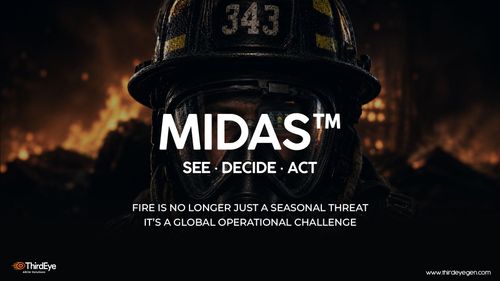
MIDAS is not a consumer AR headset. It is a hands-free display and control platform designed for users operating in protective gear when phones, tablets, touchscreens, and voice systems are difficult, unsafe, or unreliable.
The goal is simple:
Help responders see, decide, and act when traditional devices are not practical.
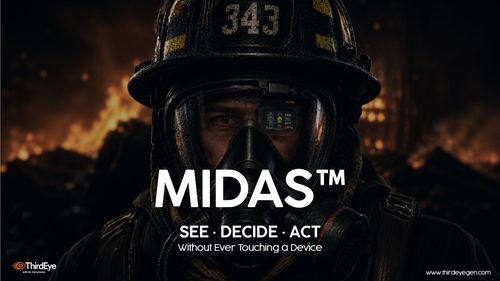
MIDAS brings critical information into the user’s field of view through a protective-gear display system. Instead of forcing a firefighter or hazmat operator to look down at a device, MIDAS is designed to show simple, high-value information directly inside or aligned with protective equipment.
This can include:
For wildfire and emergency response scenarios, this kind of information layer could help responders stay oriented, receive command updates, and reduce reliance on handheld devices in dangerous environments.
Why This Matters During Fires
During fast-moving fires, the operating environment changes by the minute. Roads close. evacuation zones shift. Visibility drops. Radio traffic becomes crowded. Teams need updated information, but they also need to keep their eyes up and their hands free.
MIDAS is designed around that reality.
Rather than overwhelming the user with a full dashboard, MIDAS focuses on a minimal interface: the right information at the right moment. A responder does not need twenty different screens in their field of view. They need clear prompts such as:
The purpose is not to add distraction. The purpose is to reduce confusion.
What Makes MIDAS Different
Most AR systems were not built for responders wearing masks, gloves, and protective gear. MIDAS is different because it is being developed around the constraints of high-risk environments.
1. Protective-gear integration
MIDAS is designed around masks, PPE, and protective environments, not standard consumer headset use.
2. Mission data, not just visualization
MIDAS is not limited to showing a camera view or thermal image. It is designed to show operational information such as alerts, routes, checklists, status, command messages, and mobile / ATAK / CIVTAK-style data.
3. Hands-free control
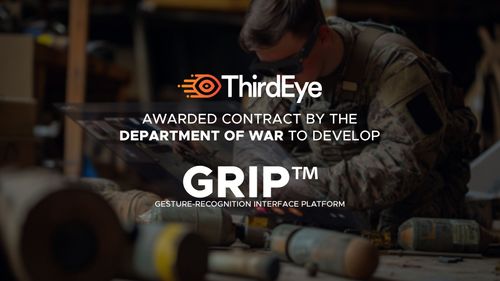
When combined with GRIP or another hands-free input method, MIDAS is intended to allow users to interact with simple commands without touchscreens, voice, or looking down.
4. Quick-hide / blackout
If the user does not want information in their field of view, they need to clear it instantly. MIDAS includes a quick-hide concept so the display can be removed from view and restored when needed.
From Fire Response to Industrial and Government Use
While current wildfire events show the urgent need for firefighter technology, MIDAS is also being designed for broader protective-gear environments.
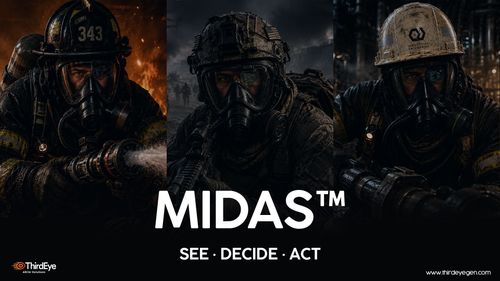
MIDAS Fire / Response supports fire, hazmat, civil protection, search and rescue, and emergency response.
MIDAS Industrial supports oil & gas, refineries, chemical plants, utilities, ports, airports, and critical infrastructure teams.
MIDAS Gov / CBRNE supports defense, CBRNE, tactical law enforcement, and government protective-gear users.
The common thread is the same: users need critical information while wearing gear that makes normal devices difficult to use.
The Path Forward: Pilot Programs and Real User Feedback
MIDAS is being positioned for controlled pilot programs and evaluation environments. The goal is not to jump straight into full live emergency deployment. The goal is to work with responders, industrial safety teams, and government users to validate the highest-value use cases.
A MIDAS pilot can help answer practical questions:
What information is most valuable?
Does the display help or distract?
Can users control it with gloves?
Is quick-hide intuitive?
Is the system comfortable enough for realistic training?
What needs to change before broader deployment?
Wildfires in Reno and Europe show why this work matters. First responders are being asked to operate in increasingly complex, dangerous, and fast-changing environments. They need tools that keep information accessible without adding friction.
MIDAS is ThirdEye’s answer to that challenge: a hands-free information layer for protective gear, built for the moments when visibility, dexterity, and voice are unreliable.
MIDAS helps responders see, decide, and act when traditional devices are not practical.